

Have you ever overtaken a computer-controlled racer, only to find it challenging you again at the next corner? Behind every convincing rival is a system making decisions about speed, steering and the other vehicles on the track. AI opponents in racing games can turn a solo session into a competitive experience without requiring other players to be online.
From traditional programmed drivers to machine-learning systems, here is how racing AI works and why it matters for VR and mixed reality gaming on devices such as Meta Quest 3 and 3S.
1. How Traditional Racing AI Finds Its Way Around a Track

One common approach is to give computer-controlled vehicles a series of invisible points called waypoints. These describe a route around the circuit. The AI uses its position and direction to decide where to steer next, while programmed rules govern its speed and braking.
This approach can produce reliable opponents without needing machine learning. However, following a route is not the same as racing intelligently. A driver that reacts too late to bends or always takes the same path can become predictable.
More sophisticated rule-based systems can anticipate corners, avoid rivals and select alternative paths. Good racing AI does not necessarily need a neural network.
2. Racing Lines, Braking and Overtaking

A racing line is the path a vehicle takes through a circuit. Instead of simply staying in the centre of the road, an AI driver can aim for a smoother route through a bend and adjust its speed before reaching it.
Developers can use information about upcoming corners, vehicle grip and nearby opponents to improve these decisions. A computer-controlled rival might slow down for a tight turn, accelerate on a straight or choose a different line to leave room for another kart.
The goal is not just a faster lap. Opponents should behave consistently enough for players to understand their actions, while offering enough variety to make another race interesting.
3. Fixed AI vs Adaptive AI: What Is the Difference?

Fixed AI uses predefined behaviour or difficulty settings. Opponents may still react to traffic, but their overall skill does not have to change as the player improves.
Adaptive AI can adjust aspects of the challenge using information about player performance. For example, a game could review lap times and adjust an opponent's target pace for a later race. Such a system can use ordinary programmed rules rather than machine learning.
Another technique is rubber-banding, where a game changes performance according to the gap between racers. Used carefully, it can keep a race close, but excessive adjustments can make wins feel artificial. A balanced challenge should reward better driving, not cancel out every advantage.
4. Can Racing AI Learn Like a Human Driver?

Machine learning introduces another approach. With reinforcement learning, an AI agent can practise in a simulated environment and improve its decisions using feedback from its actions.
A prominent example is Gran Turismo Sophy, developed through collaboration between Sony AI, Polyphony Digital and Sony Interactive Entertainment. Its training addressed vehicle control, race tactics and sporting behaviour.
Learning during development is different from learning directly from you during gameplay. A trained opponent can use an existing model without permanently adapting after every race. Sophy demonstrates the possibilities in PlayStation racing; it is not a feature of Nexus Arcade or a standalone Quest game.
5. Why Racing AI Is Different on Standalone VR Headsets

On Quest 3 and 3S, the game must share processing resources between graphics, vehicle physics, tracking and opponent decisions. Mixed-reality presentation adds further work. More complex AI is not automatically better if it compromises smooth gameplay.
Meta's Quest performance guidance emphasises maintaining a stable frame rate and identifying bottlenecks. Developers can make efficient decisions by simplifying calculations and testing on actual devices.
Nexus Dev Studio, the development team behind Nexus Arcade, works on VR and mixed-reality games, where gameplay behaviour and headset performance must be considered together.
6. What Makes an AI Rival Fun to Race Against?
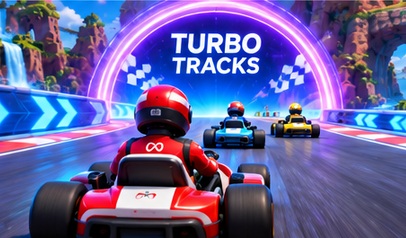
Look for opponents that offer fair competition, understandable behaviour and room to improve. The fastest possible computer driver is not always the most entertaining one.
In Turbo Tracks, players enter a virtual kart racing course through the Nexus Arcade experience. When racing, notice how your approach to corners affects your progress and try to make each run more consistent.
For more racing experiences, explore our guide to the best mixed reality racing games. Check each game's actual features rather than assuming that all AI rivals learn or adapt to individual players.
Whether an opponent follows carefully designed rules or uses a trained model, effective racing AI should make the competition engaging and rewarding. The real test is whether you want to return for another lap.
Ready to try arcade kart racing? Download Nexus Arcade free on the Meta Horizon Store for Quest 3 and Quest 3S, then explore Turbo Tracks and the other arcade experiences.